A micro-school rooted in experiential learning, blending the thoughtful rhythm of formal schooling with the fluidity of natural learning

Learning flows naturally when curiosity meets care
Adjective.
involving or based on experience and observation
Experiential
Microschool
Noun.
a small, community-based learning setup focused on personalized, flexible, student-led education
Formal education
Noun.
a setup offering structured, planned education with clear objectives, defined curriculum and qualified teachers
Natural learning
Noun.
a process of acquiring knowledge & skills organically through everyday exploration, observation & interaction
WHAT is Prakruti Learning Center ?
Prakruti Learning Center is an experiential micro-school for children aged 6–14 (we would like the child to enroll with us latest by age 14 so that we get time to work with them through the milestone of secondary education i.e. age 16). We are a small, collaborative space where learning is rooted in real life. We blend the structure of traditional schooling with the freedom of natural learning, offering rhythm without rigidity and creativity without chaos.
Children learn through exploration, conversation, art, movement, and reflection. Each day balances hands-on projects and dialogue with space for curiosity and discovery.
Learning connects to real experiences, nurturing confidence, collaboration, and self-awareness - helping children see themselves and the world with fresh eyes.


WHY was Prakruti Learning Center established ?
Prakruti was created to bridge two worlds that are often seen apart - formal schooling and alternative learning. It values the continuity, community, and shared rhythm of traditional systems while embracing the reflection, depth, and freedom of experiential learning. This balance helps families feel secure while giving children space to grow authentically.
Prakruti exists to make learning joyful and meaningful without losing direction or depth. We believe that children learn best when challenge and comfort go hand in hand - when learning feels alive but purposeful.
For parents and facilitators, Prakruti is a shared journey. Through open circles and reflection sessions, adults explore how empathy, awareness, and emotional safety form the foundation of genuine growth - for children and for themselves.
WHO learns and teaches here?
Children at Prakruti are curious explorers who learn through action, dialogue, and reflection. They work in mixed-age groups, learning with and from one another. Every child brings a different energy and rhythm, and our facilitators help channel that individuality into meaningful growth.
Facilitators balance guidance with independence. They combine the planning and coherence of traditional teaching with the adaptability and sensitivity of alternative facilitation. They design experiences that are structured enough to guide learning yet open enough to invite discovery.
Parents are active partners. They join open days and dialogues that build shared understanding between home and learning space. Families value this balanced approach - where learning is natural yet purposeful, independent yet connected.


WHERE does learning happen?
Learning at Prakruti happens in spaces designed for both focus and freedom - classrooms that feel like studios, gardens that act as laboratories, and neighborhoods that become extensions of the classroom. Each space is intentional: clear in layout, flexible in use. Children move freely between quiet work, group collaboration, and outdoor exploration.
The environment combines the order of a prepared space with the openness to be shaped by its learners. Walls display evolving work, and natural elements - sunlight, plants, air - are part of daily experience. Our learning environment reflects Prakruti’s philosophy: a steady rhythm that leaves room for movement and change.
WHEN does learning happen?
Learning at Prakruti follows a consistent rhythm rather than a rigid timetable. Days begin with dialogue circles that center attention and build community, followed by exploration, creation, and reflection. This rhythm gives children both predictability and freshness.
Children know there will be time to think, time to do, and time to share. Some inquiries unfold in a day; others continue for weeks. We respect the natural pace of understanding, trusting that real learning deepens over time.


WHICH paths and practices shape learning?
Learning at Prakruti grows through six interconnected domains: Language, Math, Environment, Arts, Movement, and Self. These domains provide direction and coherence, ensuring balance between conceptual clarity and creative expression.
Concepts evolve through lived experience - a story might lead to mapping, an experiment to art, a reflection to writing. Facilitators guide these connections so that learning stays both open and anchored: children have freedom to explore while remaining connected to core ideas.
This approach maintains academic depth and emotional balance. It helps children see how thinking, feeling, and doing are parts of the same process.
HOW do we learn, assess and grow together?
Learning at Prakruti moves through a steady cycle of Experience → Reflection → Concept → Expression. Children learn by doing, think about what they did, and share their understanding through conversation, writing, art, or presentation.
Facilitators observe learning carefully - not to label, but to understand. Behavior is seen as communication, and responses aim to build awareness and responsibility rather than compliance.
Assessment is ongoing and descriptive. Each child maintains a portfolio with work samples, reflections, and facilitator notes. Feedback highlights growth, curiosity, and next steps - reinforcing confidence and intrinsic motivation.


WHOM can you reach out to?
Families interested in Prakruti’s approach can connect with us. The Center is located in Kothrud, Pune, surrounded by greenery yet easily accessible.
Visitors are welcome to observe or join a circle to experience the rhythm of learning. We invite families who seek a middle path - those who value the balance between structure and openness, between comfort and exploration.
Prakruti belongs to its community of learners - children, parents, and facilitators who believe that learning can be joyful, rooted, and meaningful.
Answering some pertinent questions...
Is Microschooling legal in India?
Yes. Prakruti operates within the legal framework of learning centers. Parents can choose alternative learning paths such as NIOS (National Institute of Open Schooling) or SIOS (State Institute of Open Schooling, Maharashtra) for formal certification when needed. Microschools like Prakruti provide recognized learning experiences and help families transition smoothly to formal systems if required.
Which board exams are followed?
Prakruti does not follow a single board syllabus in early years. Learning is designed around national frameworks such as NEP 2020, NCF 2005, and NCF-FS 2022 to ensure conceptual alignment. For formal certification, families can choose open schooling routes such as NIOS (National Institute of Open Schooling) or SIOS (State Institute of Open Schooling, Maharashtra) when the child reaches the appropriate age. The team helps parents select the most suitable pathway and provides support for transition whenever needed.
Will this type of education be recognized for college admissions?
Yes. Students who complete NIOS or SIOS or other recognized board exams after learning at Prakruti are eligible for the same higher education options as students from CBSE, ICSE, or State Boards. Our focus on critical thinking, language, and applied understanding often helps children perform well in later formal studies and entrance exams.
What are the qualifications of the teachers/facilitators?
Facilitators at Prakruti come from diverse academic backgrounds - education, psychology, arts, sciences, and social work with an average experience of 7-8 years - but share one quality: a strong understanding of how children learn. They are trained in child development, experiential learning, and reflective practice. Many have formal teaching degrees; others bring real-life expertise that adds depth to projects. Every facilitator continues to learn through regular reflection and mentoring.
What is the schedule like and what are the school hours?
Prakruti functions in a day-school format from Monday to Saturday. Sessions usually run between 10:00 a.m. and 2:00 p.m., including exploration, project time, movement, and reflection. Timings may vary on days that include outdoor activities or visits.
How are the assessments and exams conducted?
Assessment is continuous and descriptive, focusing on progress, effort, and understanding. Facilitators observe, record, and discuss learning with each child. Portfolios, reflections, and projects form the evidence of growth. When formal exams are needed (such as for NIOS or SIOS levels), we prepare and guide children for them gradually and without stress.
How involved do parents have to be in the day-to-day schedule?
Lesser than in formal school since the notion of 'homework' is different! On a daily basis, parents are only expected to manage the child's schedule. The deeper role is to stay connected and supportive and participate in the child's learning through periodic meetings, reflection sessions and open days. Some parents voluntarily offer their expertise, experiences, or resources when relevant - for example, leading a small session, sharing professional knowledge, or contributing materials - but there is no compulsion or expectation to do so. The partnership between home and center keeps learning consistent and transparent.
What about 'homework'?
Sometimes, children are introduced to an idea or concept at the center and then extend or apply it outside - through observation, small experiments, or conversations. Homework is designed to support this natural extension of learning, not as a separate academic burden. Parents’ role is to support, not substitute the child’s effort. They may help only when the child faces a genuine difficulty - like understanding a complex idea, using resources safely, or needing supervision for outdoor or practical work. The focus is not on perfection but on participation and conversation. Even when assignments involve family members or neighbors, adults are not expected to complete the child’s work. The goal is to keep learning real, connected, and collaborative.
What the medium of learning?
What is the strength of the class?
English, Marathi, Hindi, and even Sanskrit - each language finds its place and purpose here at Prakruti. Our children engage with every conversation in every tongue with equal enthusiasm and curiosity, asking questions freely and clearing even the smallest doubts with confidence. For us, language is never a barrier - it’s a bridge that opens the floodgates to knowledge, culture, and connection beyond semantics.
We cap each class at 14-15 students to nurture meaningful learning and individual attention.


From the parents' perspective...
Priya & Nachiket Kshire
HR Professional mom | Podcaster, Author dad
अनेक कारणांमुळे पारंपारिक शाळेत आपल्या मुलाला घालायचे नाही असा निर्णय खूप आधीच झाला होता. सुदैवाने सुरवातीला ग्राममंगल सारख्या संस्थेचा आधार होता. पुढे २०२१ पासून अश्विनी गोडसे यांच्या मार्गदर्शनाखाली प्रकृती सुंदर शिक्षण अशी आमची वेगळी शाळा सुरू झाली. excitement होती पण धाकधूक पण होती. शेवटी मुलाच्या भविष्याचा प्रश्न होता. पण ४ वर्षाच्या अनुभवानंतर आम्ही अगदी योग्य निर्णय घेतला होता असं ठामपणे सांगू शकतो. ‘प्रकृती’ मधे आमचं मूल आनंदी आहे, शिकायला उत्सुक आहे आणि प्रगती करत आहे.. सगळ्या ताया अगदी मनापासून आणि पूर्ण अटेंशन देऊन मुलानं बरोबर काम करतात आणि त्यामुळे मुलांचा सर्वांगीण विकास निश्चितच होतो आहे..

Ketaki & Anand Kelkar
Commercial Photographer mom | FMCG Marketing Expert dad
“We wanted Risha to learn through curiosity and real-world experiences, not just textbooks—leading us to explore homeschooling and find Prakruti Center. This past year has been enriching. Prakruti offers a joyful, hands-on learning environment where children are encouraged to ask questions and explore deeply. The mixed-age setting fosters collaboration and emotional growth, and the personal attention each child receives is truly meaningful. We’ve seen Risha grow into a confident, curious learner. We're grateful to the Prakruti team for creating such a nurturing space and look forward to the journey ahead.
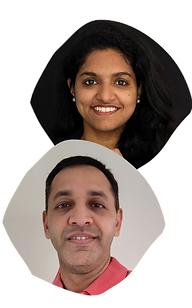

Karishma & Omkar Kulkarni
Avid reader mom | IT Professional dad
प्रकृती सुंदर शिक्षण म्हणजे नावाप्रमाणेच सहज, कृतीतून, अनुभवातून शिकण्याची जागा. इथे शिक्षण हा एक अविरत प्रवास आहे - ज्ञानाच्या शोधात मुलं सक्रियपणे सहभागी होतात. ही प्रक्रिया जितकी नैसर्गिक वाटते, तितकीच तिच्यामागे सर्व ताईंचा सततचा अभ्यास आणि परिश्रम आहेत. मुलं इथे "शिकायचं कसं?" हे शोधत असतात, आणि त्या शोधात त्यांना विचार, भावना, आणि संवाद गवसतो. आम्हा पालकांचाही प्रवास तितकाच अर्थपूर्ण ठरतो - चर्चा, कार्यशाळा, अनुभवातून आम्हीही शिकत जातो. पुलंच्या भाषेत सांगायचं तर इथे शिक्षण तिहेरी आहे - पालक, मुले आणि ताई सगळेच शिकत असतात. इथल्या अभ्यासक्रमाची मांडणी विचारपूर्वक केली जाते. संकल्पना चर्चा, कृती, आणि अनुभवातून साकार होतात, त्यामुळे मुलं आत्मविश्वासाने विचार मांडतात आणि सहभागी होतात. प्रत्येक अनुभवात वैचारिक बैठक असून तो आनंददायीही असतो. स्वयं-अध्ययनाचं स्वातंत्र्य आणि ताईंचं मार्गदर्शन यामुळे मुलं एकमेकांशी, ताईंशी आणि परिसराशी गहनपणे जोडली जातात. आमचाही हा प्रवास त्यांच्या सोबत अखंड चालू आहे.
Suchitra & Darsshan Wagh
Communications Professional mom | Sports Scientist dad
We always wanted to give our daughter a stress-free, impactful and application-based education. Fate was gracious enough to lead us to Ashwini, Nivedita and Prajakta and we saw our daughter’s personality unfold beautifully under their wings. All the benefits that we thought this education model would give her - the actual impact was way more in terms of small subliminal changes we observed along the way. We are more than confident of continuing on this journey with the committed and extremely knowledgeable team of Prakruti under the leadership of Prajakta and Nivedita.

Dhanashree & Raghunath Thakar
Alapini's parents | Alapini was one of the first learners at PRAkruti, before relocating to Germany
“Raghunath and I were always clear about giving Alapini a learning platform that feeds her curiosity and allows her to explore the practical world around her. Prakruti resonated with us on that level and we are proud to have been a part of the foundational process of building this learning ecosystem. When our jobs brought us to Germany and Alapini started school here, we realised the significance of that decision back in India and how it became easy for her to adapt to the German model of education - which also emphases holistic development and practical skills. We both are sure that these kids will turn out to be strong, resilient adults because of this groundwork happening at Prakruti right now! We wish them all the best!”